Wednesday, November 17, 2010

Winxp Tips And Tricks, Winsock 2 repair

Winxp Tips And Tricks, Winsock 2 repair

WinXP Tips & Trix - Winsock 2 Repair

--------------------------------------------------------------------------------
Repairing Damaged Winsock2

The symptoms when Winsock2 is damaged show when you try to release and renew the IP address using IPCONFIG...

And you get the following error message:

An error occurred while renewing interface 'Internet': An operation was attempted on something that is not a socket.

Also Internet Explorer may give the following error message:
The page cannot be displayed Additionally, you may have no IP address or no Automatic Private IP Addressing (APIPA) address, and you may be receiving IP packets but not sending them.

There are two easy ways to determine if Winsock2 is damaged:

From the XP source files, go to the Support / Tools directory

Winsock Test Method 1
Run netdiag /test:winsock

The end should say Winsock test ..... passed

Winsock Test Method 2

Run Msinfo32
Click on the + by Components
Click on the by Network
Click on Protocol
There should be 10 sections if the Winsock2 key is ok
MSAFD Tcpip [TCP/IP]
MSAFD Tcpip [UDP/IP]
RSVP UDP Service Provider
RSVP TCP Service Provider
MSAFD NetBIOS [\Device\NetBT_Tcpip...

If the names are anything different from those in this list, then likely Winsock2 is corrupted and needs to be repaired.
If you have any 3rd party software installed, the name MSAFD may be changed.
There should be no fewer than 10 sections.

To repair Winsock2

Run Regedit
Delete the following two registry keys:
HKEY_LOCAL_MACHINE\System\CurrentControlSet\Services\Winsock
HKEY_LOCAL_MACHINE\System\CurrentControlSet\Services\Winsock2

Restart the computer
Go to Network Connections
Right click and select Properties
Click on the Install button
Select Protocol
Click on the Add button
Click on the Have Disk button
Browse to the \Windows\inf directory
Click on the Open button
Click on the OK button
Highlight Internet Protocol (TCP/IP)
Click on the OK button
Reboot

23 Ways To Speed WinXP, Not only Defrag

Since defragging the disk won't do much to improve Windows XP performance, here are 23 suggestions that will. Each can enhance the performance and reliability of your customers' PCs. Best of all, most of them will cost you nothing.
1.) To decrease a system's boot time and increase system performance, use the money you save by not buying defragmentation software -- the built-in Windows defragmenter works just fine -- and instead equip the computer with an Ultra-133 or Serial ATA hard drive with 8-MB cache buffer.

2.) If a PC has less than 512 MB of RAM, add more memory. This is a relatively inexpensive and easy upgrade that can dramatically improve system performance.

3.) Ensure that Windows XP is utilizing the NTFS file system. If you're not sure, here's how to check: First, double-click the My Computer icon, right-click on the C: Drive, then select Properties. Next, examine the File System type; if it says FAT32, then back-up any important data. Next, click Start, click Run, type CMD, and then click OK. At the prompt, type CONVERT C: /FS:NTFS and press the Enter key. This process may take a while; it's important that the computer be uninterrupted and virus-free. The file system used by the bootable drive will be either FAT32 or NTFS. I highly recommend NTFS for its superior security, reliability, and efficiency with larger disk drives.

4.) Disable file indexing. The indexing service extracts information from documents and other files on the hard drive and creates a "searchable keyword index." As you can imagine, this process can be quite taxing on any system.

The idea is that the user can search for a word, phrase, or property inside a document, should they have hundreds or thousands of documents and not know the file name of the document they want. Windows XP's built-in search functionality can still perform these kinds of searches without the Indexing service. It just takes longer. The OS has to open each file at the time of the request to help find what the user is looking for.

Most people never need this feature of search. Those who do are typically in a large corporate environment where thousands of documents are located on at least one server. But if you're a typical system builder, most of your clients are small and medium businesses. And if your clients have no need for this search feature, I recommend disabling it.

Here's how: First, double-click the My Computer icon. Next, right-click on the C: Drive, then select Properties. Uncheck "Allow Indexing Service to index this disk for fast file searching." Next, apply changes to "C: subfolders and files," and click OK. If a warning or error message appears (such as "Access is denied"), click the Ignore All button.

5.) Update the PC's video and motherboard chipset drivers. Also, update and configure the BIOS. For more information on how to configure your BIOS properly, see this article on my site.

6.) Empty the Windows Prefetch folder every three months or so. Windows XP can "prefetch" portions of data and applications that are used frequently. This makes processes appear to load faster when called upon by the user. That's fine. But over time, the prefetch folder may become overloaded with references to files and applications no longer in use. When that happens, Windows XP is wasting time, and slowing system performance, by pre-loading them. Nothing critical is in this folder, and the entire contents are safe to delete.

7.) Once a month, run a disk cleanup. Here's how: Double-click the My Computer icon. Then right-click on the C: drive and select Properties. Click the Disk Cleanup button -- it's just to the right of the Capacity pie graph -- and delete all temporary files.

8.) In your Device Manager, double-click on the IDE ATA/ATAPI Controllers device, and ensure that DMA is enabled for each drive you have connected to the Primary and Secondary controller. Do this by double-clicking on Primary IDE Channel. Then click the Advanced Settings tab. Ensure the Transfer Mode is set to "DMA if available" for both Device 0 and Device 1. Then repeat this process with the Secondary IDE Channel.

9.) Upgrade the cabling. As hard-drive technology improves, the cabling requirements to achieve these performance boosts have become more stringent. Be sure to use 80-wire Ultra-133 cables on all of your IDE devices with the connectors properly assigned to the matching Master/Slave/Motherboard sockets. A single device must be at the end of the cable; connecting a single drive to the middle connector on a ribbon cable will cause signaling problems. With Ultra DMA hard drives, these signaling problems will prevent the drive from performing at its maximum potential. Also, because these cables inherently support "cable select," the location of each drive on the cable is important. For these reasons, the cable is designed so drive positioning is explicitly clear.

10.) Remove all spyware from the computer. Use free programs such as AdAware by Lavasoft or SpyBot Search & Destroy. Once these programs are installed, be sure to check for and download any updates before starting your search. Anything either program finds can be safely removed. Any free software that requires spyware to run will no longer function once the spyware portion has been removed; if your customer really wants the program even though it contains spyware, simply reinstall it. For more information on removing Spyware visit this Web Pro News page.

11.) Remove any unnecessary programs and/or items from Windows Startup routine using the MSCONFIG utility. Here's how: First, click Start, click Run, type MSCONFIG, and click OK. Click the StartUp tab, then uncheck any items you don't want to start when Windows starts. Unsure what some items are? Visit the WinTasks Process Library. It contains known system processes, applications, as well as spyware references and explanations. Or quickly identify them by searching for the filenames using Google or another Web search engine.

12.) Remove any unnecessary or unused programs from the Add/Remove Programs section of the Control Panel.

13.) Turn off any and all unnecessary animations, and disable active desktop. In fact, for optimal performance, turn off all animations. Windows XP offers many different settings in this area. Here's how to do it: First click on the System icon in the Control Panel. Next, click on the Advanced tab. Select the Settings button located under Performance. Feel free to play around with the options offered here, as nothing you can change will alter the reliability of the computer -- only its responsiveness.

14.) If your customer is an advanced user who is comfortable editing their registry, try some of the performance registry tweaks offered at Tweak XP.

15.) Visit Microsoft's Windows update site regularly, and download all updates labeled Critical. Download any optional updates at your discretion.

16.) Update the customer's anti-virus software on a weekly, even daily, basis. Make sure they have only one anti-virus software package installed. Mixing anti-virus software is a sure way to spell disaster for performance and reliability.

17.) Make sure the customer has fewer than 500 type fonts installed on their computer. The more fonts they have, the slower the system will become. While Windows XP handles fonts much more efficiently than did the previous versions of Windows, too many fonts -- that is, anything over 500 -- will noticeably tax the system.

18.) Do not partition the hard drive. Windows XP's NTFS file system runs more efficiently on one large partition. The data is no safer on a separate partition, and a reformat is never necessary to reinstall an operating system. The same excuses people offer for using partitions apply to using a folder instead. For example, instead of putting all your data on the D: drive, put it in a folder called "D drive." You'll achieve the same organizational benefits that a separate partition offers, but without the degradation in system performance. Also, your free space won't be limited by the size of the partition; instead, it will be limited by the size of the entire hard drive. This means you won't need to resize any partitions, ever. That task can be time-consuming and also can result in lost data.

19.) Check the system's RAM to ensure it is operating properly. I recommend using a free program called MemTest86. The download will make a bootable CD or diskette (your choice), which will run 10 extensive tests on the PC's memory automatically after you boot to the disk you created. Allow all tests to run until at least three passes of the 10 tests are completed. If the program encounters any errors, turn off and unplug the computer, remove a stick of memory (assuming you have more than one), and run the test again. Remember, bad memory cannot be repaired, but only replaced.

20.) If the PC has a CD or DVD recorder, check the drive manufacturer's Web site for updated firmware. In some cases you'll be able to upgrade the recorder to a faster speed. Best of all, it's free.

21.) Disable unnecessary services. Windows XP loads a lot of services that your customer most likely does not need. To determine which services you can disable for your client, visit the Black Viper site for Windows XP configurations.

22.) If you're sick of a single Windows Explorer window crashing and then taking the rest of your OS down with it, then follow this tip: open My Computer, click on Tools, then Folder Options. Now click on the View tab. Scroll down to "Launch folder windows in a separate process," and enable this option. You'll have to reboot your machine for this option to take effect.

23.) At least once a year, open the computer's cases and blow out all the dust and debris. While you're in there, check that all the fans are turning properly. Also inspect the motherboard capacitors for bulging or leaks. For more information on this leaking-capacitor phenomena, you can read numerous articles on my site.

Following any of these suggestions should result in noticeable improvements to the performance and reliability of your customers' computers. If you still want to defrag a disk, remember that the main benefit will be to make your data more retrievable in the event of a crashed drive.

System File Checker For Windows Xp

Scans and verifies the versions of all protected system files after you restart your computer. Syntax

sfc [/scannow] [/scanonce] [/scanboot] [/revert] [/purgecache] [/cachesize=x]

Parameters

/scannow
Scans all protected system files immediately.
/scanonce
Scans all protected system files once.
/scanboot
Scans all protected system files every time the computer is restarted.
/revert
Returns the scan to its default operation.
/purgecache
Purges the Windows File Protection file cache and scans all protected system files immediately.
/cachesize=x
Sets the size, in MB, of the Windows File Protection file cache.
/?
Displays help at the command prompt.

Remarks

* You must be logged on as a member of the Administrators group to run sfc.
* If sfc discovers that a protected file has been overwritten, it retrieves the correct version of the file from the %systemroot%\system32\dllcache folder, and then replaces the incorrect file.
* If the %systemroot%\system32\dllcache folder becomes corrupt or unusable, use sfc /scannow, sfc /scanonce, or sfc /scanboot to repair the contents of the Dllcache directory.

Formatting legend

Format Meaning
Italic Information that the user must supply
Bold Elements that the user must type exactly as shown
Ellipsis (...) Parameter that can be repeated several times in a command line
Between brackets ([]) Optional items
Between braces ({}); choices separated by pipe (|). Example: {even|odd} Set of choices from which the user must choose only one
Courier font Code or program output

Windows File Protection

Using File Signature Verification

Driver Signing for Windows

Command-line reference A-Z

Please note that this Command Line reference is to varify the integrity of the WindowsXP DLL's that were shipped with Windows XP. It will try to repair damaged DLL's by prompting for the Windows CD.

The Windows XP System File Protection which remains active in the background monitors these DLL's and if it detects an altered DLL will alert a user with a popup message asking for the Windows XP CD. This is so that it can revert the corrupt DLL back to its original state.

SFC checker in Windows XP can only be ran by an Administrator and is not ran in the same way as its previous incarnation from the Windows 98 OS.

Reset your lost Bios Password

Here's a DOS trick for Windows 9x, that will reset (delete) your motherboard's BIOS password (aka CMOS password) without any need to open up your computer to remove the battery or mess with jumpers.

This method can come in very handy in the event you ever lose and forget your BIOS password or if you acquire used computers where the unknown previous owners had BIOS passwords set (in fact, this happened to me long ago—I was given a used computer, but there was no way I could enter the CMOS to make changes). It's important to note here that the password we are talking about is only the one that prevents a user from entering the BIOS setup at bootup, not the one that stops you from getting past the boot.

Normally, at bootup you can press a key (usually the DEL key) to access your BIOS allowing you to view it or make changes. With a password set, there is no way to enter setup. Though a password can provide a basic and very effective level of PC security, losing it can be a real headache if you don't know how to fix the problem.

The MS-DOS command that will makes this trick possible is the DEBUG command (debug itself is a utility—debug.exe—which is located in your Windows Command folder). This is not a command to be taken lightly—in other words, it's not a command to play with! You can cause serious corruption with this command and can end up not being able to even boot your computer! Debug is used to work with binary and executable files and allows you to alter (hex edit) the contents of a file or CPU register right down to the binary and byte level.

To begin debug mode, type debug at a MS-DOS prompt or you can specify a file, i.e., DEBUG FILE.EXE. There is a difference in screen output between the two methods. When you type DEBUG alone, debug responds with a hyphen (-) prompt waiting for you to enter commands. The second method, with a file specified, loads the file into memory and you type all the commands on the line used to start debug. In this tip, we will be writing to the BIOS, so the first method is the one that would be used. All debug commands can be aborted at any time by pressing CTRL/C.

Accessing BIOS with DEBUG
The basic trick will be to fool the BIOS into thinking there is a checksum error, in which case it resets itself, including the password. This is done by invalidating the CMOS and to do that we must know how to access the BIOS and where the checksum value of the CMOS is located so that we can change it. Access to the the BIOS content is via what are known as CMOS Ports and it's Port 70 and 71 that will give us the needed access. On almost all AT motherboards, the checksum is located at hexadecimal address 2e and 2f and filling the address 2e with ff is all you should have to do to invalidate the checksum.

Here's what to do if you ever need to reset the password and have no other method, and you don't want to open up your computer to remove the battery or jumpers.

Note! Do this at your own risk. I can only tell you that it has worked for me more than once and has worked for others as well. But I cannot make any guarantees. When I did this, I took a willing risk. The BIOS was Award Modular BIOS v4.51PG

Restart your computer in MS-DOS mode.

When you get to the C:\> or C:\WINDOWS> prompt, type DEBUG and press Enter.

A hyphen (-) prompt will appear waiting for you to enter commands.

Enter the following commands, pressing Enter after each one. Note: the o is the letter o and stands for OUTPUT.

o 70 2e

o 71 ff

q

After the q command (which stands for QUIT), enter Exit.

Then try to enter your BIOS at bootup. The password prompt should now be gone and you should now have full access to it again. However, you will now be at the default BIOS setttings and may want to change them to your preference. You may also want to have your drives autodetected again.
In closing, I should state that in the case of a lost BIOS password, your first step should always be to contact your manufacturer to see if a backdoor password is available that will allow you to bypass the forgotten password.

There are many sites on the net that list backdoor passwords you can try, but beware that some BIOS that are set up to lock up if you enter the wrong password more than a certain number of times, usually only 3 times!

Firefox Tweaks

Firefox Tweaks

http://www.theforumz.com/forumz/showthread.php?postid=251495#post251495

QUOTE
http://brilliantcorners.org/2004/02/12/make-a-great-browser-even-better

QUOTE
http://www.hicksdesign.co.uk/journal/545/

QUOTE
http://www.tweakfactor.com/articles/tweaks/firefoxtweak/ **Very good**

How To Make Your Own Radiostation

::Must HAVE Winamp (Any Version)::
First, things First your speed has to be at least 256/64 kbps (which means Dial-up users, will have alot of latency, just dnt bother)
Second, your going to have to have a domain, an updated one with the current i.p active. (Could be anything e.g. My sig)

Now, Your gonna have to download the Shoutcast Files.

Go to www.shoutcast.com to get the files.

Ok After downloading these, installing Both of them in any order i dnt care. Go to START>PROGRAM FILES>SHOUTcast DNAS>EDIT SHOUTCAST DNS CONFIG.

Ok your gonna have to Configure it:
Go Down and where it says password: change (that means your gonna have to change it to whatever, make sure u remember)
The Portbase: change it to whatever port you want it
Maxusers: (lets be realistic here, dnt put in 10000, like NXS's radio station) your bandwidth has to be extremely good, if your cable, 50 user max is ok, ADSL should stay below 10 users, and T1 connections should do whatever tickles there fantasy.

EDIT>SAVE.

Open winamp, RIGHT CLICK>OPTIONS>PREFRENCES>DSP EFFECT> and choose the NULLSOFT SHOUTCAST.

Go to OUTPUT, and then click on Connection, Through the ADDRESS, type your address which you have done through www.no-ip.com, PORT NUMBER, whatever u did in the EDIT.txt, and your password.

Then go to Encoder, and choose your quality of your music. Go back to OUTPU>OUTPUT CONFIG> YELLOW PAGES. this is your advertisemant information. dow hatever you like there.

Now Connect. to check that your Radio os on-line go to http://(your address that you added in the prefrence)

Tuesday, November 16, 2010

HOW TO BE ALLWAYS IDEAL IN GTALK OR HOW TO BE NEVER IDEAL IN GATALK

Back when Gmail Chat hadn’t introduced the Invisible mode, there was no way you could remain invisible from your Gtalk friends when logged in. I was using a program called gAlwaysIdle then, and when I’m just busy I just use it to change my status to ‘Idle’ on Google Talk.

The Invisible mode doesn’t work when you’re using both Google Talk and Gmail chat simultaneously. That’s when gAlwaysIdle could home handy. this is the tool for be always be  ideal or not ideal in gtalk . enjoy it.

how to use it.

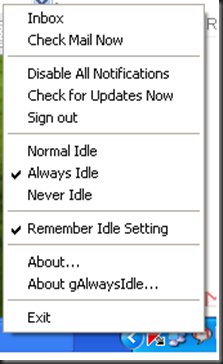
right click on gtalk icon in task bar

and you have see the menu lile below

use your desired option .. ..

 gtalk ideal DOWNLOAD NOW