
Tuesday, February 28, 2012

History - Rulers of British India
History - Rulers of British India

Please wait while images are being loaded.....
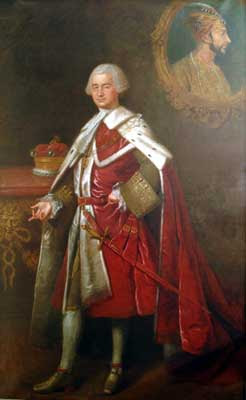
Robert Clive (1757-60) (1765-67)
1. Robert Clive started his career as a clerk in the English East India Company, and he became the Governor of Bengal, following the victory of the Company forces under him in the Battle of Plassey (1757). The Battle of Plassey laid the foundation of the British Empire in India.
2. Roger Drake held the post of the Governor of Bengal for a brief period before Clive.
3. Governor of Bengal twice; from 1757 - 60 and again from 1765-67.
4. Started dual Govt. in Bengal in 1765. It was a system intended to obtain the services of the officials of the erst-while Nawab of Bengal in revenue administration.
5. He forbade the servants of company from indulging in private trade and made payment of internal duties by them obligatory.
6. Bengal White Mutiny by the European brigades at Allahabad and Monghyr, they were arrested and tried.
7. Following the first tenure of Clive, Holwell officiated as the Governor of Bengal for a brief time, followed by Vansittart (1760-1765).
8. Henry Verelst (1767-69) and Cartier (1769-72) succeeded Clive after his second term.
9. The Battle of Buxar was fought and won by the Company forces (1764) when Vansittart was the Governor. The English forces were led by Holwell and the peace treaty (Treaty of Allahabad) was negotiated by Clive. The Battle of Buxar secured the British Empire in India.
10. When he returned to England, Clive was charged with corrupting the political life of England with the ill-gotten money in India. The charges against him included acceptance of bribe and abusing the office of the Governor of Bengal.
11. Though Clive was acquitted, he led a desperate life and committed suicide.
Please wait while images are being loaded.....
Warren Hastings (1772-85)
1. Became the Governor of Bengal in 1772 and Governor - General in 1774, following the Regulating Act (1773). It was the first Act passed on India by the British Parliament. Following this, the British Parliament got some law-making powers over the land in India, ruled by the English East India Company.
2. Introduced quinquennial settlement of land revenue in 1772 farming out of lands to the highest bidder, later on he reversed to annual settlement (1777) on the basis of open auction to the highest bidder
3. Abolished ‘Dual Government’ in 1772.
4. Created a Diwani and Fuajidari Adalat in 1772.
5. With the passage of the Regulatory in Act in 1773, he became the first to hold the post of Governor General in 1774.
6. Divided Bengal into revenue districts and made appointment of the collectors and the other revenue officials. Thus, the system of collectors heading the administration of revenue districts began.
7. Codified Hindu & Muslim Laws (1776).
8. Trial of Nand Kumar and his judicial murder in 1775.

prayer in school essay

Intro-
Contrary to the claims, students have the Constitutional right to pray in school, either individually or in informal groups so long as the prayer is not organized by the school. But if the students only knew what they were really doing by praying in school. II. First of all they are going against the Bible. As to quote, Matthew 6:5-6: "And when you pray, do not be like the hypocrites, for they love to pray standing in the synagogues and on the street corners. But when you pray, go into your room, close the door and pray..." So as you can see those who pray in places such as the cafeteria, middle of the hall or things of that nature is actually going against the bible. Now I am not saying that a person should not pray in schools, but they should do it just as the Bible says in a personal place. If a student can't find a personal place, and have an undesirable need to pray, they need to not make a big deal out of it. Praying as put in the Bible is a personal experience between that person and God. Not an event to be proclaimed up and down the hallway. III. Another problem there is with praying in schools is the fact that there are some students who don't believe in God. The purpose of a 

Hinduism and Buddhism essay

Introduction-
Hinduism and Buddhism are two of the five major religions in our world today. They are widely practiced, and have survived for centuries. Both have similarities and differences, as do all forms of religion. Hopefully, in this paper I will show you the basic structure of each religion. I would also like to show how they compare and contrast.
Hinduism: Foundation
No one is completely sure of where Hinduism was started and by whom. Their oldest written documents, the Vedas, were written down in 1000 B.C. but they had existed orally long before. The Vedas are where Hinduism originated. Today, Hinduism is the world's third largest religion. Many changes have come upon Hinduism since they practiced it first. Hinduism includes many different sects, or denominations, and beliefs that have arisen. Though, there are many things in common with all of the Hindu sects. Their basic beliefs are what ties them together.


Monday, February 27, 2012

Brief history of Buddhism essay

Brief history of Buddhism
Buddhism is one of the major religions of the world. It
was founded by Siddhartha Guatama (Buddha) in Northeastern
India. It arose as a monastic movement during a time of
Brahman tradition. Buddhism rejected important views of
Hinduism. It did not recognize the validity of the Vedic
Scriptures, nor the sacrificial cult which arose from it. It
also questioned the authority of the priesthood. Also, the
Buddhist movement was open to people of all castes, denying
that a person's worth could be judged by their blood.
The religion of Buddhism has 150 to 350 million 

Information About Viruses short essay

Information About Viruses
A growing problem in using computers is computer viruses. Viruses are pesky little programs that some hacker with too much time on his hands wrote. Viruses have been known to create annoyances from displaying messages on the screen, such as "Your PC is now stoned," to completely obliterating everything that is contained on the computer's hard disk. Viruses are transferred from computer to computer in a number of ways. The most common way that users receive viruses at home are downloading programs off the internet, or off of local Bulletin Board Systems, or BBSs. These viruses are then transferred to a floppy disk when written to by the infected computer. Computers can also be infected when a disk that is infected with a virus is used to boot the computer. When this computer is infected, every one who writes a floppy disk on this computer gets 

history of computer essay

 
The volume and use of computers in the world are so great, they have become difficult to ignore anymore. Computers appear to us in so many ways that many times, we fail to see them as they actually are. People associated with a computer when they purchased their morning coffee at the vending machine. As they drove themselves to work, the traffic lights that so often hampered us are controlled by computers in an attempt to speed the journey. Accept it or not, the computer has invaded our life.
The origins and roots of computers started out as many other inventions and technologies have in the past. They evolved from a relatively simple idea or plan designed to help perform functions easier and quicker. The first basic type of computers were designed to do just that; compute!. They performed basic math functions such as multiplication and division and displayed the results in a variety of methods. Some 

essay on welcome to the internet

Good evening I would like to welcome you all here this evening to our symposium on "Then & Now the Evolution of a society"
Things Have Changed dramatically since the 1920's
This Panel of researchers that you see before you are here to talk to you about the events and issues from the past 75 years that have led up society as we know it today.
starting from left to right I would like to Introduce this panel to you
first we have Lori who is an expert in the political arena and she will touch on a few issues on how politics itself has not really changed but how the politicians get there message across has
Next to her we have Yolanda who is an expert on African American leaders and the profound effect they have made in the Last 75 years.